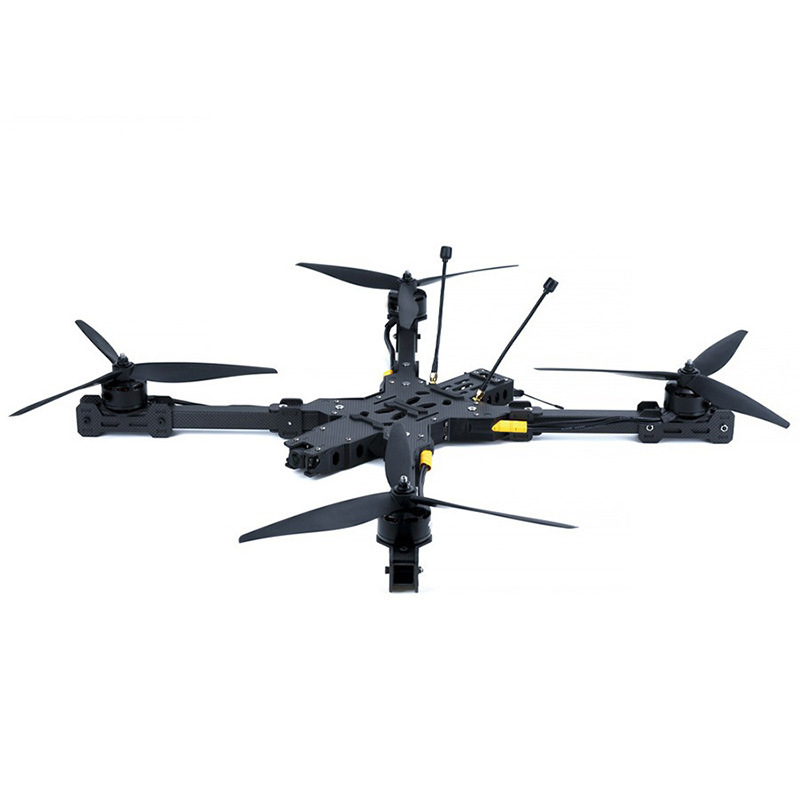
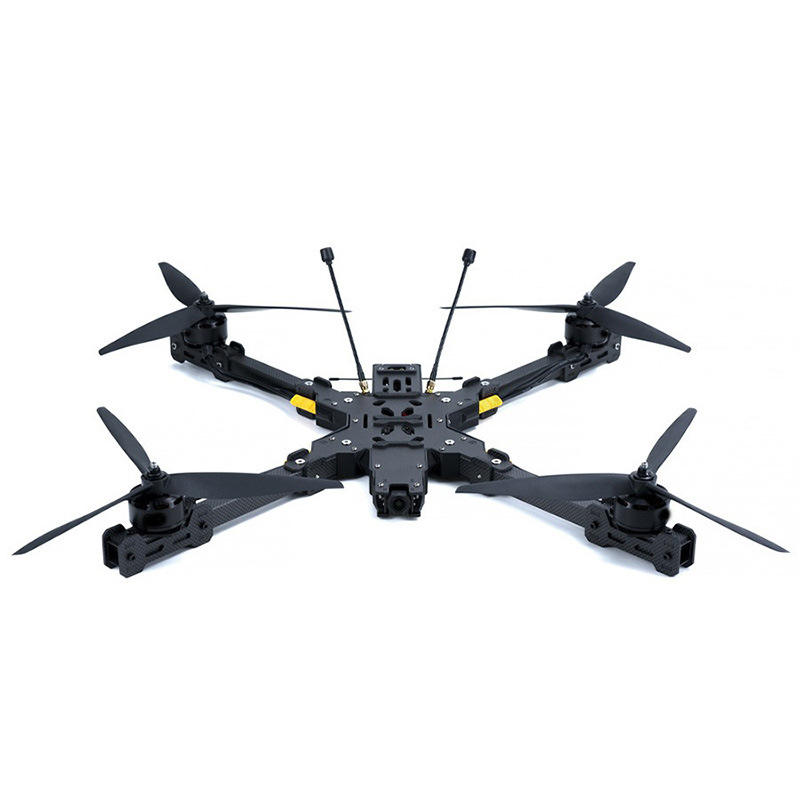
Core Identity & Purpose
A 13-inch drone serves one of three specific missions:
-
Maximum Endurance/Long-Range Mapping: Carrying multi-cell Li-Ion battery packs (6S6P, 6S8P) for flight times measured in hours, not minutes. Used for surveying, mapping, or simply extreme distance records.
-
Heavy Payload Carrying: Lifting professional cinema cameras (Blackmagic Pocket Cinema, small mirrorless), specialized sensors (multispectral, LiDAR, thermal), or delivery payloads (up to 2-3kg).
-
High-Altitude Operations: Efficient flight in thin air, where large props are necessary to move sufficient air mass.
This is NOT an FPV drone in the traditional freestyle/cinematic sense. It's an unmanned aerial vehicle (UAV) that happens to use FPV technology for piloting.
Key Design Philosophy
-
Efficiency is Everything: Every component is chosen for its grams-per-watt efficiency, not peak performance.
-
Low RPM, High Torque: Motors spin large props slowly to maximize efficiency.
-
Redundancy & Reliability: Systems are often duplicated (dual GPS, dual receivers, backup power).
-
Professional-Grade Components: Industrial ESCs, aviation connectors, and professional flight controllers are common.
Component Breakdown
1. Frame
-
Custom or Industrial: You're likely designing/building this yourself or buying from a specialist manufacturer like V1 Engineering, UAV Works, or collaborating with a machinist.
-
Material: Thick, multi-layer carbon fiber or aircraft-grade aluminum for the arms. The center plate is often a "power distribution board" (PDB) with integrated wiring.
-
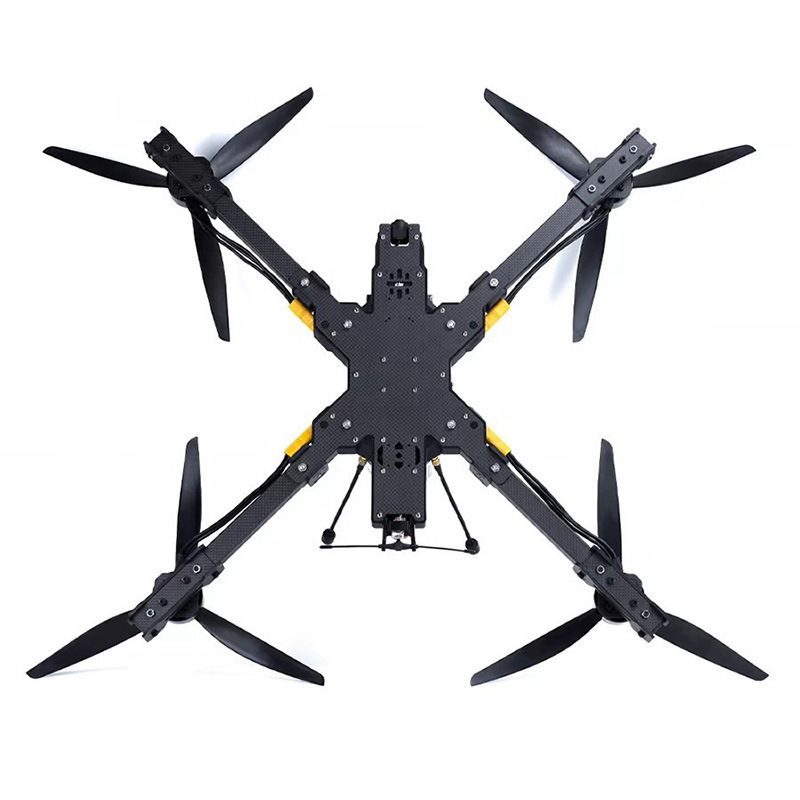
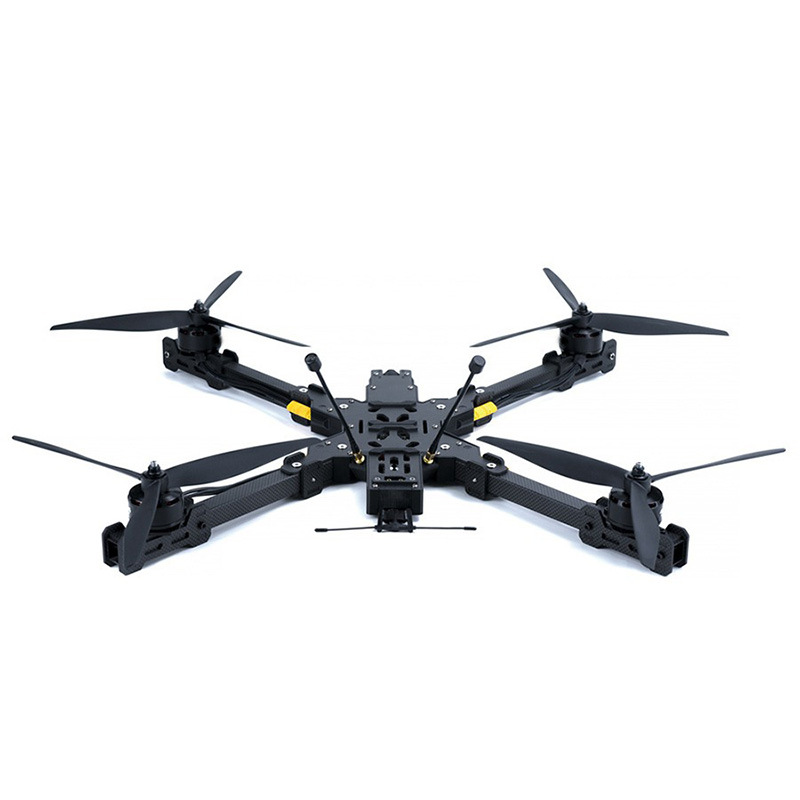
Design: Hexacopter (6 motors) or Octocopter (8 motors) configurations become common at this size for redundancy and lift capacity. A large quadcopter is possible but less common.
-
Size: Arms are 400mm+ long. Total diagonal motor-to-motor distance is often 1000mm+ (1 meter).
2. Propulsion System
-
Motors:
-
Size: 50xx, 60xx, or even 80xx stator sizes (e.g., 5010, 6012, 8008). These are low KV, high-torque outrunner motors.
-
KV: 100-500KV on 6S or 12S (44.4V) power systems. Extremely low RPM per volt.
-
Mounting: Large bolt patterns (25mm+), 6-8mm motor shafts. Often used with bullet connectors, not direct solder.
-
Propellers:
-
13x4, 13x5, 13x6, 14x4.8 are typical sizes. Often carbon fiber or reinforced plastic.
-
Pitch is Low: Optimized for static thrust and efficient cruise, not speed.
-
Balancing is MANDATORY: A professional propeller balancer is required.
3. Flight Controller & Electronics
-
Flight Controller: Moves beyond Betaflight to more capable firmware:
-
ArduPilot (Pixhawk-series FCs): The industry standard for this class. Offers fully autonomous mission planning, advanced failsafes, waypoint navigation, and telemetry logging.
-
iNav: A middle ground, but less feature-rich than ArduPilot.
-
Betaflight OSD: Sometimes used in parallel via a separate module for the FPV feed, while ArduPilot handles flight.
-
ESCs: Individual 80A-120A BLHeli_32 or BLHeli_S ESCs, often with active cooling. They are mounted on the arms near the motors to reduce weight and heat in the center.
-
Power Distribution: Custom PDB or heavy-duty power module capable of handling 100A+ continuous current. XT90 or AS150 connectors are standard.
4. Power System
-
Voltage: 6S (22.2V) or 12S (44.4V). 12S is preferred for efficiency at high power, allowing lower current for the same wattage.
-
Batteries:
-
Li-Ion (NMC 21700): 6S4P to 6S8P configurations for endurance. Capacity of 20,000-30,000mAh. Flight times of 60-120+ minutes.
-
LiPo: For high-power payload lifting (e.g., 12S 10,000-16,000mAh). Shorter flight times (15-30 mins) but high discharge.
-
Power Monitoring: High-precision current sensors (e.g., Holybro PM02) for accurate battery telemetry.
5. FPV & Control Links (Mission-Critical)
-
Control Link: 900MHz is the baseline. Common setups:
-
TBS Crossfire Diversity with two receivers.
-
ExpressLRS 900MHz at 1W+ with a backup receiver on a different protocol (e.g., FrSky R9).
-
Mavlink over 4G/LTE: For beyond-line-of-sight commercial ops, using a cellular telemetry dongle.
-
Video Link:
-
Digital (DJI O3, Walksnail): For primary piloting within ~10km.
-
Analog 1.3GHz: For extreme range with high-gain ground stations (helical antennas).
-
Often Dual-System: A primary digital link and a low-bandwidth analog backup.
-
Ground Station: Not just goggles. A laptop or tablet running Mission Planner (for ArduPilot) displaying live telemetry, maps, and drone status is essential.
6. Navigation & Safety (Non-Negotiable)
-
Dual/Redundant GPS: Two high-precision GPS modules (Ublox M8, M9, or M10) with compasses, placed far apart to avoid interference.
-
Pitot Tube: For precise airspeed measurement (critical for autonomous missions).
-
ADS-B Receiver: (e.g., uAvionix Ping) to detect and avoid manned aircraft.
-
Redundant Power: Backup battery for the flight controller and receivers.
-
Loud Locator Beacon: With independent power.
7. Payload
-
Gimbals: Brushless motorized gimbals (e.g., Gremsy, DJI Ronin) for cinematic cameras.
-
Quick-Release Mechanisms: For interchangeable payloads.
-
Auxiliary Power: Dedicated 12V/24V regulated output for cameras/sensors.
Estimated Costs & Build Process
-
Drone-Only Build: $2,500 - $8,000+. High-torque motors, large carbon props, industrial ESCs, and professional flight controllers are very expensive.
-
Full Professional Setup: $10,000 - $25,000+. Including ground control station, multiple high-capacity batteries, professional charger, high-end radio system, tracking antenna system, and payload.
-
Build Time: This is a multi-week engineering project, not an afternoon build. Requires advanced soldering, wiring, and configuration skills.
Critical Considerations & Warnings
1. Legal & Regulatory
-
You are now in "commercial drone" regulatory territory.
-
In the USA: This will certainly exceed the 55lb / 25kg limit for Part 107 operations without special waivers. You will need a Part 107 license at a minimum, and likely need to apply for waivers for BVLOS, altitude, or operations over people.
-
Worldwide: Check your local aviation authority (EASA in Europe, CASA in Australia, etc.). Registration, insurance, and pilot certification are mandatory.
-
Airspace: Flight planning and NOTAMs become part of your pre-flight ritual.
2. Safety
-
This is a potentially lethal aircraft. A 13-inch carbon fiber prop spinning at even moderate RPM can cause severe injury or death. The kinetic energy of a 4-5kg drone falling from altitude is enormous.
-
First flights MUST be in a completely isolated, controlled area (authorized RC airfield, private land miles from people).
-
Pre-flight checks are exhaustive and must follow a written checklist.
3. Skill Required
-
Aerodynamic Knowledge: Understanding lift, drag, and efficiency curves.
-
Advanced Electronics: Diagnosing noise issues, managing large power systems.
-
Software Expertise: Configuring ArduPilot, tuning PID loops for large frames, scripting autonomous missions.
-
Piloting: The flying experience is like piloting a small airplane, not an FPV drone. Turns are wide and slow. Depth perception via FPV is challenging at this scale.
Is This For You?
Ask yourself these questions:
-
Do I have a specific professional/commercial need that cannot be met by a 7" or 10" drone?
-
Am I prepared to navigate complex aviation regulations and obtain necessary certifications?
-
Do I have an engineering background and the budget for a project of this scale?
-
Do I have access to safe, legal locations large enough to test and fly this aircraft?
If you answered "no" to any, a 10-inch or smaller platform is your better path.
Final Verdict
A 13-inch FPV drone is a serious, professional unmanned aerial vehicle. It exists at the intersection of hobbyist FPV technology and commercial UAV operations. It is built for specific missions requiring extreme endurance or heavy lifting, governed by strict regulations, and demands engineering rigor.
This is not the next step after a 10-inch drone for most people. It's a parallel path for professionals, researchers, or dedicated enthusiasts whose goal is capability, not just scale. For the overwhelming majority of FPV pilots, the journey ends at 7-10 inches—and that's where the most accessible fun is found.
Next Steps: If you're serious, start with the ArduPilot documentation and join communities focused on heavy-lift UAVs and mapping drones, not mainstream FPV groups. Your peers will be aerospace engineers and commercial operators, not freestyle pilots.